About Ole
View photographs ↓Welcome to ARNBAK BANJOS
Contact email: oarnbak@fiddle.dk
"HANDCRAFTED BANJOS FOR HANDMADE MUSIC"
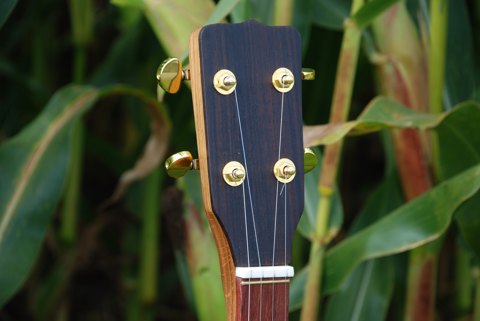
This is not a website intended for selling. It is about my hobby: building banjos for clawhammer and old-time music. The idea is to spread interest in handmade clawhammer banjos. Imagine if more people in Denmark felt inspired to build one. That is why I am working on some form of practical building guide. Not many people in Denmark build their own banjo; it is much more common in the USA. Visit Arnbak Banjos on YouTube, where there are now more than 80 videos about my banjos. The banjos are built using old, traditional methods. I mainly use dry, seasoned, sustainable reclaimed wood. Danish oak in particular has proved to have surprisingly good qualities as a tonewood. I find my oak in various second-hand shops, sometimes in old furniture. I also use beech, ash, paulownia, walnut, mahogany, teak, spruce and other woods. For fretboards I use ebony, ash, mahogany and rosewood.
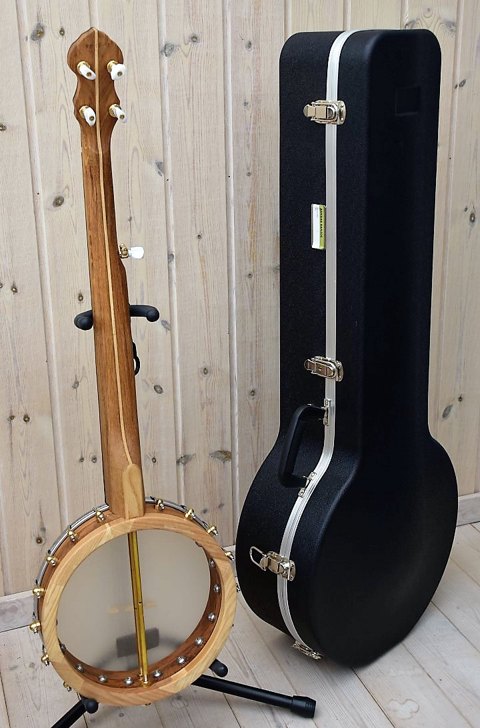
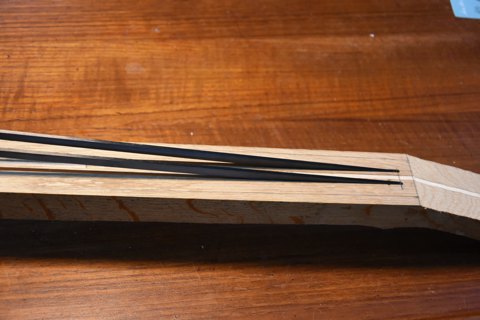
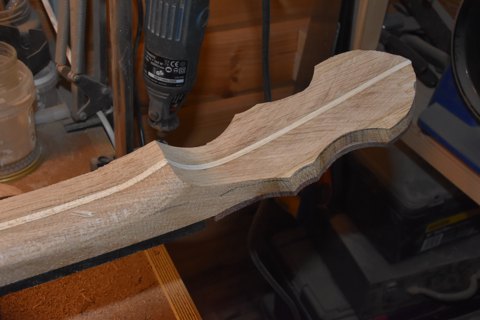
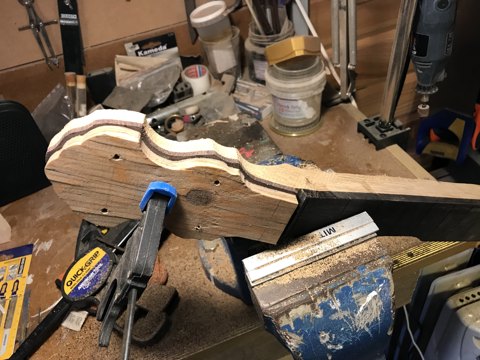
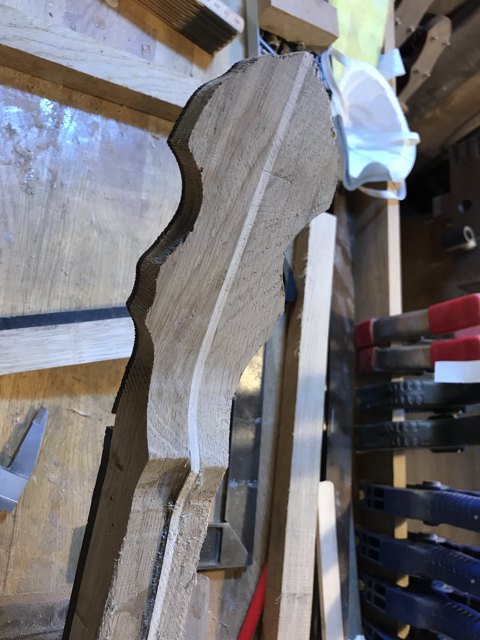
The banjo necks are laminated from three layers of solid wood. They may therefore seem more substantial than the necks on modern, machine-made banjos. Modern banjos have an adjustable metal truss rod inside the neck. On my banjos, it is mainly the natural strength of the wood that keeps the neck stable. You see the same thing in vintage banjos from makers such as Vega. They still hold up well, like good old wooden ships. The strong, stable neck also benefits the banjo's overall sound.
Note: I sometimes use two carbon fibre truss rods for extra neck reinforcement. Banjos with carbon fibre truss rods carry the designation "NX" after the build number.
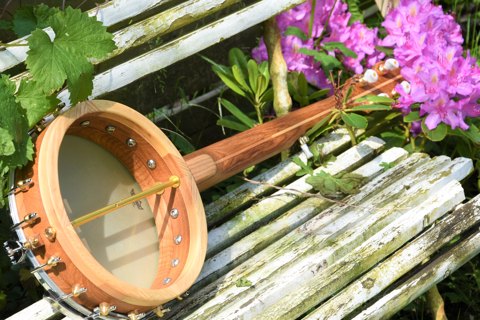
I build my necks a little wider at the nut, for example 3.6–4.0 cm. This increases the space between the strings and gives the fingers more room. Several professional banjo players reportedly appreciate this. The distance between the strings and the fretboard must not be too large, though it can always be fine-tuned using the two coordinator rods. I prefer the strings close to the fretboard. I make my own coordinator rods from solid brass.
I deliberately build my banjos without much decoration. The grain and character of the wood give each banjo natural simplicity and personality.
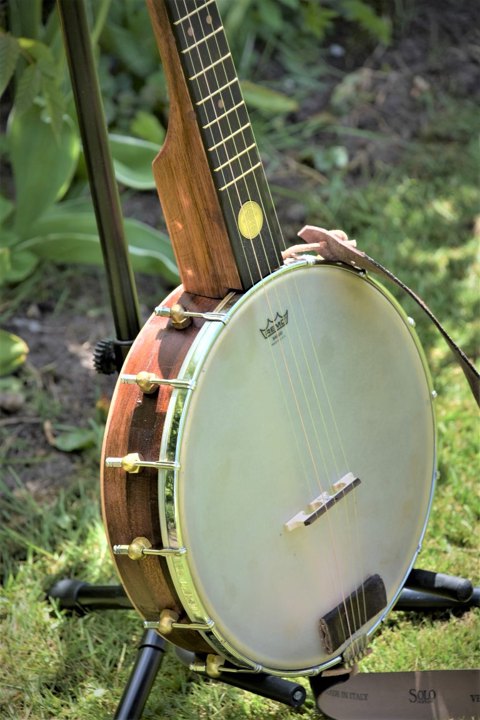
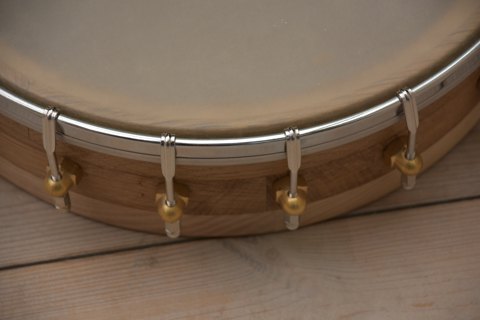
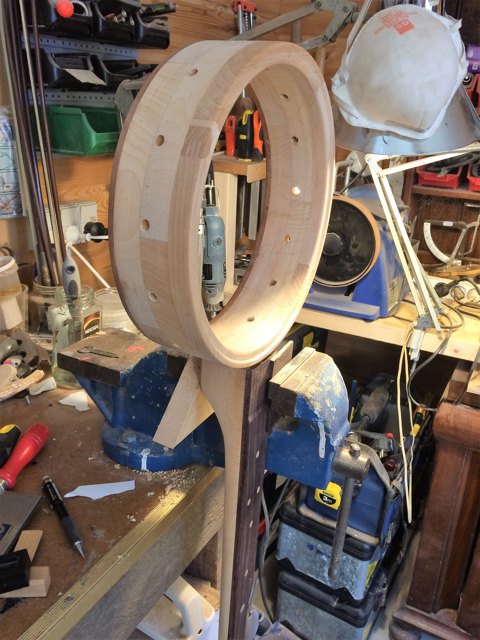
The pots are made as block rims. These take a little longer to make but, in my opinion, offer particular advantages. The plunky tonal qualities of the wood are highlighted, especially in clawhammer playing. Block rims are very stable and strong. The sound improves as the wood settles. The banjos are robust, suitable for daily professional use, and easy to service and adjust.
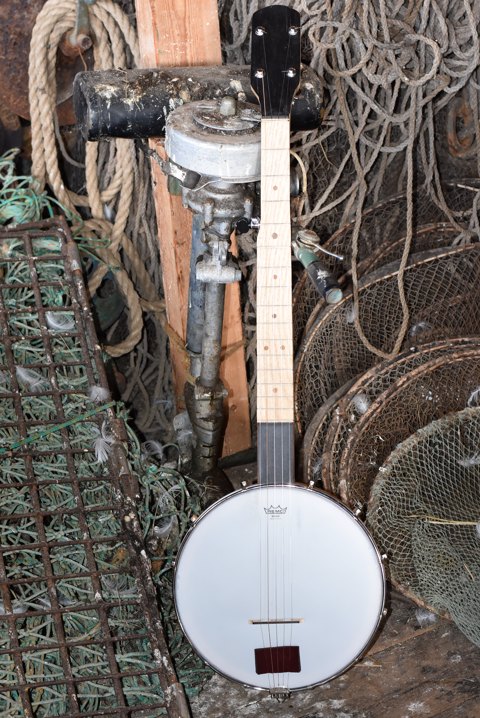
My main focus is traditional open-back banjos, either G-scale or A-scale for clawhammer.
The simplest banjo to build uses a prefabricated plywood rim with a metal tone ring. The pots can be bought on eBay. I upgraded the pot and fitted a handmade neck. I also explore how cheaply I can make a really good banjo. Could it be made from spruce from Jem & Fix? One day we would find out. The answer is now clear: yes, and successfully too. See banjo no. 21E, "Granjo".
Whether a banjo should have a metal tone ring is a matter of taste in sound; neither choice is more correct. Personally, I favour integrated wooden tone rings. This is where oak's individual tone and sound can be a pleasant surprise. The species of wood and the design of a wooden tone ring greatly affect the sound. I continue to explore this with great curiosity. When I fit metal tone rings, I use rolled brass. These enhance the banjo's sound while still working well with the wood's qualities described above.
The wood is mainly treated with oil, such as furniture oil, gunstock oil or Danish oil. I prefer oil because it brings out the wood's individual character. It is also easy to maintain and straightforward to work with.
I have been an amateur folk musician for almost forty years. Around 15 years ago, through my involvement in Folkskovlund, I really noticed the clawhammer old-time style. Since then I have worked at learning to play clawhammer as a hobby, and at some point began building clawhammer banjos. Because I play myself, I am critical about how an instrument feels to play. My banjos will therefore never be completely new and untouched. I have played them in, which is an advantage because small faults are corrected and the wood settles.
My banjos will always be unique, for good reason: my annual production is less than one! I build purely for pleasure, just as I play for pleasure.
So my advice to anyone wanting to build a banjo is: do it for pleasure.
Alongside handmade banjos, I also do a little work on building nyckelharpas, mainly inspired by the old Mora harpa. The original Mora harpa can be seen at the Zorn museum in Mora. I also have plans to build leather armchairs. We shall see; they need to be designed first.
As mentioned, my plan is to produce a clawhammer-banjo building guide that can be downloaded from this website.
A film about the building process has now been recorded. It can be seen under NEWS.
I also offer to come out to play and talk about Arnbak Banjos: "How do you build an open-back banjo?"
See more about my talks at www.fiddle.dk.
Contact me by email: oarnbak@fiddle.dk
I am always ready for a chat about banjos and welcome good advice and craft tips. Clawhammer banjos are my hobby.
"HANDMADE BANJOS FOR HANDMADE MUSIC"
My banjos are built accoding to the old traditional methods of craftmannship. I mainly use dry and stored recycled second hand types of wood. In particular, danish oak has proved to have surprisinly fineproperties as tonewood. Its environmentally sustainable wood. I allso use walnut,beech,ash,paulownia,mahogany and other types of woods. For fretboard i prefure ebony, rosewood and ash.
The necks are mainly laminatedwith three layes of solid wood. Some banjonecks will allso be maounted with carbon fiber truss rods. These very banjos are mark with a NX. I build my banjonecks a bit more width at the nut. 3,6 to 3,9cm. It gives slightly greater distance between the strings and increases the space for the fingers to play melodies. There are several professional banjo players who appreciate this.
On the premium line banjos, the pots are made as blockrims. The sound properties of the wood are highlighted, blockrims are very strong and stable. The sound improves as the wood settles.
My E-folks banjos with prefabricated plywood rims has a metal tonering. Whether a banjo should have a metal tonering or not is a matter of sound taste. One is therefore no more correct the other. Personally, I have penchant for integrated wooden tonerings. It is here the wood´s personal tone and sound surprises positively.
My primary building focus is preferably traditional openbacks. Either G-scales or A-scales fore clawhammer. At times,however, a longneck banjo can up on the planer bench and rarely a tenor banjo.
For almost forty years I have been an amateur folkmusic fiddler. About 12 years ago, through my participation in Folkskovlund, I rearly watched the clawhammer oldtime playingstyle. Since then and with help from my friends and youtube I have been working on learning how to play clawhammer and at one point I started to build my first banjo. Since I am playing folkmusic I am very critical of how the instrument behave. I use all my banjos, which is an advantage because small errors are corrected and the wood settles.
You are allways wellcome to mail me at: oarnbak@fiddle.dk
See more if you visit Arnbak Banjos on YouTube.Photographs
This page was last updated on 23 June 2026